
Key Takeaways
- Two totally different documents: The factory window sticker and the dealer addendum serve completely different purposes.
- The factory baseline: The official window sticker shows the real MSRP, standard features, and factory-installed options.
- Dealer extras: A dealer addendum lists dealer-installed accessories, protection packages, and additional market markups.
- Verify using the VIN: Running a quick VIN lookup for the original window sticker makes it super easy to verify the true factory MSRP and build specs.
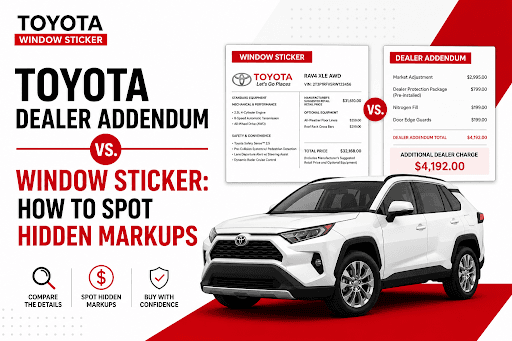
If you've ever walked around a new Toyota on a dealership lot, you've probably noticed more than one sticker stuck to the glass. Most buyers just assume they're all official documents coming straight from Toyota, but that's definitely not the case.
One sticker comes directly from Toyota and shows exactly how the vehicle left the factory. The second one is added later by the dealership, and it often includes extra accessories, added fees, or even a hefty market markup above the original retail price.
The tricky part is that they can look pretty similar at first glance. If you don't know the difference, it's easy to assume every line item on that window is an official factory charge.
Understanding the difference between a dealer markup sticker vs. the original factory window sticker helps you see exactly what you're paying for, so you can decide whether those extra line items are actually worth your hard-earned money.
What Is a Toyota Window Sticker?
The Toyota window sticker, often called the Monroney label, is the official sticker required on every brand-new Toyota sold in the United States. It's printed by Toyota, not the local car dealership, and federal law dictates that it must be displayed.
Think of it as the vehicle's permanent birth certificate. It details exactly how that Toyota was spec'd and built before it ever hit a car hauler.
Original MSRP
One of the main things you'll see right away is the MSRP (Manufacturer's Suggested Retail Price). This is Toyota's official suggested price for the vehicle, including any factory-installed packages and the destination fee. What it doesn't include are local dealer markups or aftermarket add-ons.
That's precisely why the official MSRP and the dealer's final asking price aren't always the same number.
Factory Equipment
The sticker details all the standard equipment that comes with that specific trim. Depending on what you're looking at, you'll see breakdowns for the engine, transmission, safety systems, infotainment tech, and interior features included straight from the assembly line.
Factory Options
If the vehicle was built with extra packages or options from the plant, they'll show up in the Optional Equipment section. You'll see things like:
- Premium Package
- Technology Package
- Cold Weather Package
- TRD Off-Road Package
Keep in mind: These are official factory options installed by Toyota, not aftermarket dealer add-ons!
Fuel Economy and Safety Ratings
The factory label also houses official EPA fuel economy estimates and government crash safety ratings. These figures remain identical no matter which dealership ends up selling the vehicle, as they're part of Toyota's standardized documentation.
What Is a Dealer Addendum?
A dealer addendum is a secondary sticker slapped onto the glass by the dealership after the car arrives on their lot. Unlike the factory window sticker, Toyota has zero hand in creating it.
Instead, it lists products, protection packages, or services the dealership added locally, along with whatever extra profit charges they want you to pay. Some dealer addendums are pretty simple, while others can add thousands of dollars to the final price tag.
What You'll Usually Find on a Dealer Addendum
Every dealership handles these differently, but common items include:
- Window tinting
- Paint protection film or ceramic coatings
- Fabric guard
- Wheel locks
- Nitrogen tire fills
- VIN etching
- Aftermarket security systems
- "Dealer Adjustment" or "Market Adjustment" fees
Some buyers like having things like window tint already taken care of. Others would rather buy the vehicle completely stock and skip those fees altogether. That's why it's super important to know which items came straight from Toyota and which ones were added by the dealer's service department.
READ ALSO: Toyota Factory vs. Port-Installed Options: What's Your Window Sticker Really Telling You?
Dealer Addendum vs. Window Sticker
At first glance, both stickers might look completely official, but they play two totally different roles:
| Toyota Window Sticker | Dealer Addendum |
|---|---|
| Created directly by Toyota | Created locally by the dealership |
| Required by federal law | Entirely optional |
| Displays official factory MSRP | Displays dealer pricing and added fees |
| Lists factory equipment and packages | Lists dealer-installed products and services |
| Standardized for that exact build | Varies wildly from one dealer to the next |
← Scroll horizontally to see more →
Once you know what to look for, it's way easier to separate the real factory equipment from the extra dealer add-ons.
Why You Should Compare Both Stickers
Imagine you're cross-shopping two brand-new Toyota Camrys. They have the exact same trim, the same paint color, and the same factory packages.
One dealership lists the car strictly for its official MSRP. The second dealership puts a dealer addendum next to the window sticker featuring window tint, wheel locks, paint protection, and a $3,000 "market adjustment."
If you don't check both stickers, you might just assume the higher-priced Camry comes loaded with extra factory features. Once you compare the factory window sticker with the dealer addendum, the real reason for that price gap becomes crystal clear.
How to Spot Hidden Markups
Not every item on a dealer addendum is a total rip-off. Some buyers actually want those accessories or services. The main goal is just making sure you know what you're paying for before you sign anything.
1. Compare the MSRP First
Check the base MSRP on the original factory window sticker first. If the dealer's final asking price is significantly higher, look directly at the addendum to see where that extra cost is hiding. Sometimes it's a straight market markup; other times, it's a bundle of overpriced dealer accessories.
2. Look at the Accessories
Dealer addendums love to highlight aftermarket accessories like:
- Tinted windows
- Paint protection film
- Door edge guards
- Wheel locks
- VIN etching
- Security tracking units
Some buyers find these handy, but others would prefer to save money or get those installed by a third-party shop later.
3. Separate Factory Options from Dealer Extras
This is where a lot of car shoppers get confused. Factory options are already baked into the original window sticker because Toyota built the car with them. Dealer extras were added in the shop after delivery. Make sure you know which category you're paying for.
4. Ask Questions
If you see a charge on that addendum sticker that doesn't make sense, just ask! A good, reputable dealership will explain what each charge is, why it was added, and whether it's negotiable or removable. It's always better to ask before signing the sales contract.
READ ALSO: How to Get an Original Toyota Window Sticker for an Older Used Toyota (Step-by-Step)
How to Verify the Original MSRP
Whether you're shopping for a used Toyota or just want to double-check a dealer's claims on a new one, pulling the original factory window sticker is the best way to get the true baseline.
Step 1: Grab the VIN
Find the car's 17-character VIN. You can spot it:
- On the driver's side dashboard near the bottom of the windshield.
- Inside the driver's door jamb on the safety sticker.
- On official registration or insurance paperwork.
- Printed on the vehicle's title.
Step 2: Head over to ToyotaWindowSticker.com
Drop the VIN right into the window sticker lookup tool. After submitting the form, you'll be able to generate the original factory window sticker in a few seconds.
Step 3: Compare the Numbers
Review the factory breakdown for:
- Base MSRP and total factory price
- Installed option packages
- Standard equipment
- Exterior and interior colors
Then compare those numbers directly against the dealer's addendum sticker. It's easily the simplest way to see what came from Toyota versus what was added by the dealership.
Note: If an original digital window sticker isn't available for an older or classic model, a build sheet can usually be pulled using the VIN instead.
Are Dealer Addendums Always Bad?
Not necessarily. Some dealerships install high-quality accessories that buyers actually want, and having them ready to go right off the lot can be super convenient.
The main thing is making sure you're totally comfortable with the final price tag. If the addendum includes items you don't really care about, or if the market markup feels way too steep, it never hurts to ask the dealer to remove those items or drop the charges. Every dealership handles pricing differently, so shopping around can save you thousands!
Final Thoughts on Dealer Addendum vs. Window Sticker
The factory window sticker and the dealer addendum might sit side-by-side on the glass, but they tell two completely different stories.
One shows you exactly how Toyota built the car and what it originally cost out of the factory. The other shows what the dealership added after it arrived on the lot.
Taking a quick minute to compare both stickers lets you see what you're actually paying for, helps you ask the right questions, and keeps you from overpaying for dealer markups. It's a quick, easy step that makes buying your next Toyota a whole lot smoother!
FAQ on Toyota Dealer Addendum vs. Window Sticker
What is a Toyota dealer addendum?
A Toyota dealer addendum is a secondary sticker placed on a vehicle by the dealership to list dealer-installed accessories, protection packages, or added markups. It is completely separate from the official factory window sticker.
Is a dealer addendum the same as the window sticker?
No, a dealer addendum is not the same as the window sticker. The window sticker comes directly from Toyota and details official MSRP and factory equipment, while the addendum is created by the dealership to show localized fees or extras.
Can dealerships charge more than MSRP?
Yes, dealerships can charge more than MSRP. They often use dealer addendums to add "market adjustments" or mandatory dealer-installed accessories that raise the final selling price above Toyota's suggested retail price.
Does the factory window sticker include dealer accessories?
No, the factory window sticker does not include dealer accessories. Factory stickers only display equipment and options installed by Toyota at the assembly plant. Dealer add-ons appear on the separate addendum sticker.
Can I look up the original Toyota window sticker?
Yes, you can look up the original Toyota window sticker. Entering the 17-character VIN into ToyotaWindowSticker.com allows you to retrieve the original factory sticker and verify the true MSRP if records are available.