
Key Takeaways
- Factory-installed options are added while the Toyota is being built.
- Port-installed options are added after production but before the vehicle reaches the dealership.
- Both appear on the original Toyota window sticker.
- Dealer-installed accessories are different and usually don't appear on the factory window sticker.
- Looking up the original window sticker is one of the easiest ways to verify a Toyota's equipment.
If you've ever looked at a Toyota window sticker, you've probably noticed a long list of options and accessories. Heated seats, roof racks, floor mats, running boards, premium audio... it all looks like it came with the vehicle from day one.
The thing is, not everything on that sticker was installed at the factory.
Some options are added while Toyota is building the vehicle. Others don't get installed until after production, when the vehicle reaches one of Toyota's processing ports before being shipped to the dealership. By the time it's sitting on the lot, you'd never know there was a difference.
Does that actually matter? In a lot of cases, yes.
Whether you're buying a used Toyota, comparing two similar listings, or just curious about your own vehicle, understanding the difference can help you read the window sticker properly and know exactly what the vehicle originally came with.
Factory-Installed vs. Port-Installed Options at a Glance
If you're new to this, here's the simplest way to think about it.
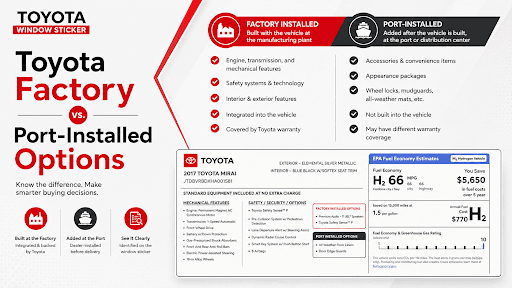
Factory-installed options become part of the vehicle while it's being assembled. Port-installed options are genuine Toyota accessories that get added after the vehicle has already been built but before it's delivered to the dealer.
Both are original Toyota equipment. The only real difference is when they're installed.
What Are Factory-Installed Options?
Factory-installed options are features Toyota installs during production. They're usually things that can't be added easily later, or at least not without a lot of work.
Some common examples include:
- Panoramic moonroof
- JBL® Premium Audio
- Heated or ventilated seats
- Larger infotainment display
- TRD suspension upgrades
- Hybrid powertrain components
- Premium interior materials
If you're looking at a Tacoma TRD Off-Road, features like the upgraded suspension and locking rear differential were installed while the truck was being built. They aren't accessories someone bolted on later. They're part of the truck's original factory configuration.
That's why the original window sticker is so useful. It tells you exactly which factory options the vehicle left with, even years after it was first sold.
Why Factory Options Matter
This is where the window sticker becomes really useful.
Imagine you're looking at two used Toyota Highlanders. They're the same model year, similar mileage, and even the same color. The prices are close too.
Then you check the window stickers.
One originally came with the Premium Package, panoramic roof, JBL audio system, and ventilated seats. The other one didn't.
Suddenly, they're not really equal anymore.
Without the window sticker, there's a good chance you'd never know one vehicle originally cost several thousand dollars more because of the options it came with.
What Are Port-Installed Options?
Here's something a lot of people don't realize. A Toyota can be completely built and still have genuine Toyota accessories added before it reaches the dealership.
Those are called port-installed options, or PIOs.
Instead of being installed at the factory, these accessories are fitted at one of Toyota's processing ports before the vehicle is shipped to the dealer.
Some of the most common port-installed options include:
- All-weather floor liners
- Cargo tray
- Roof rack cross bars
- Running boards
- Mudguards
- Wheel locks
- Door edge guards
- Cargo net
- Black emblem overlays
They're still genuine Toyota accessories, and they'll usually appear on the original window sticker with their individual prices.
Some buyers think port-installed options are the same as dealer add-ons. They're not. Toyota installs these before the vehicle reaches the dealership, making them part of the vehicle's original equipment.
Why Does Toyota Use Port-Installed Options?
You might be wondering why Toyota doesn't just install everything at the factory.
The biggest reason is flexibility.
Accessories like floor mats, mudguards, cargo organizers, and roof racks are much easier to install after the vehicle has been built. It also lets Toyota prepare vehicles for different markets without slowing down production.
For example, one RAV4 might leave the factory exactly the same as another. But before delivery, one gets roof rack cross bars and all-weather floor liners because that's what the dealer ordered, while the other doesn't.
Both are original Toyota vehicles. They were simply finished differently before arriving at the dealership.
Factory-Installed vs. Port-Installed Options
By now, you've probably realized that both types of options are original Toyota equipment. The difference isn't quality. It's simply when they were installed.
Here's a quick comparison.
| Factory-Installed Options | Port-Installed Options |
|---|---|
| Installed during production | Installed after production |
| Added at the manufacturing plant | Added at a Toyota processing port |
| Usually major features or packages | Usually accessories and appearance items |
| Harder to add later | Easier to install later |
| Listed on the window sticker | Also listed on the window sticker |
← Scroll horizontally to see more →
So, is one better than the other?
Not really.
If your RAV4 came with roof rack cross bars as a port-installed option instead of from the factory, it doesn't make the vehicle less valuable or less "original." They're both genuine Toyota equipment.
How to Find These Options on a Toyota Window Sticker
The easiest place to look is the Optional Equipment section.
This is where you'll usually see individual accessories, option packages, and their prices. Depending on the vehicle, you might also see package names that include several features grouped together.
For example, a window sticker could list something like:
| Option | MSRP |
|---|---|
| Premium Package | $2,190 |
| All-Weather Floor Liners | $309 |
| Roof Rack Cross Bars | $315 |
| Mudguards | $150 |
← Scroll horizontally to see more →
Looking at this section tells you a lot more than simply knowing the trim level. It shows exactly what the original buyer paid to have that Toyota equipped.
Dealer-Installed Accessories Aren't the Same Thing
Factory-installed options and port-installed options are both part of the original Toyota build record. Dealer-installed accessories are different.
After a vehicle arrives at the dealership, the dealer can choose to add things like:
- Paint protection
- Window tint
- Nitrogen-filled tires
- Security systems
- Wheel upgrades
- Interior protection packages
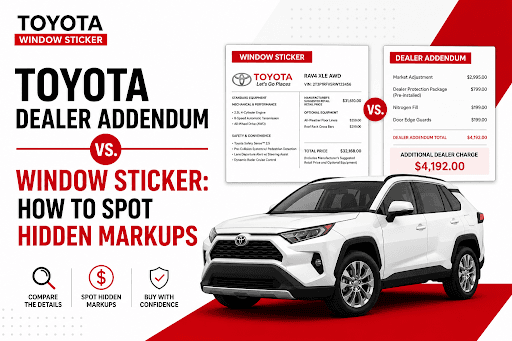
Those extras usually appear on a dealer addendum sticker, not the original Toyota window sticker.
That's an important difference because some dealer add-ons can add thousands of dollars to the final selling price.
Why This Matters When Buying a Used Toyota
Let's say you're comparing two used Toyota Tacomas.
They're both the same year, the same trim, and they're both listed for around $38,000. At first glance, they look almost identical.
Then you pull the window stickers.
One originally came with running boards, all-weather floor liners, a bed mat, and a tonneau cover. The other one came with none of those.
They're still both Tacomas, but one offers a little more value for about the same money.
Without the window sticker, you probably wouldn't know the difference.
That's why checking the original equipment list is worth the extra minute or two.
Can You Find These Options Using the VIN?
Yes.
If you have the vehicle's VIN, you can retrieve its original Toyota window sticker and see how it was equipped when it was first sold.
That includes:
- Factory-installed options
- Port-installed accessories
- Original MSRP
- Option packages
- Trim level
- Standard equipment
It's one of the easiest ways to verify that a used Toyota matches the seller's description.
Final Thoughts on Toyota Factory vs. Port-Installed Options
Factory-installed options and port-installed options both tell part of your Toyota's story. One was added while the vehicle was being built, and the other before it reached the dealership. Either way, both are original Toyota equipment, and both can affect the vehicle's value.
If you're buying a used Toyota, don't just look at the trim level. Pull the original window sticker and compare the equipment. It only takes a minute, and it can tell you a lot more about the vehicle than photos ever will.
FAQ on Toyota Factory vs. Port-Installed Options
What does PIO mean on a Toyota window sticker?
PIO stands for Port-Installed Option. These are genuine Toyota accessories installed after production but before the vehicle reaches the dealership.
Are port-installed options covered by Toyota?
Yes. Since they're genuine Toyota accessories installed before delivery, they're generally covered under Toyota's applicable warranty when the vehicle is sold new.
Can I add factory-installed options later?
Some can be added, but many can't. Features like upgraded suspension, panoramic roofs, or hybrid components are usually part of the original build.
Are dealer accessories listed on the factory window sticker?
No. Dealer-installed products normally appear on a separate dealer addendum sticker.
How can I see what options my Toyota originally came with?
The easiest way is to look up the original window sticker using the vehicle's VIN.