
Key Takeaways
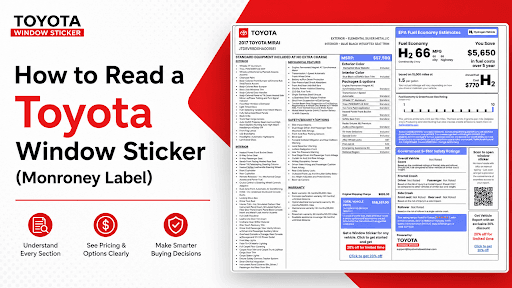
- A Toyota window sticker, also known as the Monroney label , explains how the vehicle was built and equipped at the factory, pretty much from the start.
- It lists the MSRP, trim level, engine, transmission , standard features , optional packages, safety ratings, warranty specifics, and fuel economy.
- You can identify factory-installed and port-installed options directly from the window sticker.
- If the original sticker is missing, you can generate a replacement using the vehicle's VIN.
If you’ve ever looked at a Toyota window sticker and thought, what do all these numbers, codes, and abbreviations even do… you’re definitely not the only one. Most folks only catch the MSRP and the fuel economy part, but honestly the sticker holds more than just that price tag.
In this guide we’ll sort out each section of a Toyota window sticker in plain terms. After you’re done, you’ll know what every field is saying, and you can even use it to confirm the vehicle’s original setup.
Need a copy of your Toyota window sticker? Just enter your VIN in the form on this page and you can retrieve your vehicle’s original factory window sticker in just a few clicks.
What Is a Toyota Window Sticker?
A Toyota window sticker is the official label attached to every new Toyota before it leaves the dealership. Federal law requires manufacturers to display this label on all new passenger vehicles sold in the United States.
You may also hear it called the Monroney label, named after Senator Mike Monroney, who sponsored the law requiring manufacturers to provide transparent pricing and vehicle information to buyers.
Unlike dealer advertisements or online listings, the Monroney label comes directly from the manufacturer. That makes it one of the most trustworthy sources for verifying how a Toyota was originally built.
A genuine Toyota window sticker typically includes:
- Vehicle identification number (VIN)
- Model and trim
- Engine and transmission
- Exterior and interior colors
- Standard equipment
- Optional packages
- Factory-installed options
- Port-installed accessories
- MSRP
- Destination and delivery charge
- Fuel economy ratings
- Safety ratings
- Warranty information
- Manufacturing location
Whether you're buying a used Tacoma, selling a RAV4, or restoring a classic Land Cruiser, the window sticker provides valuable information that may no longer appear in current dealership listings.
Why Learning to Read a Toyota Window Sticker Matters
Many buyers glance at the sticker for the price and never look at the rest. That means they often miss details that could affect the vehicle's value, performance, or resale price.
Understanding your Toyota window sticker can help you:
- Verify the original trim level.
- Confirm factory-installed options.
- Identify optional packages.
- Spot missing or replaced equipment.
- Compare two similar vehicles more accurately.
- Verify the original MSRP.
- Check fuel economy ratings.
- Confirm warranty information.
- Avoid buying vehicles that have been incorrectly advertised.
For example, imagine two used Toyota 4Runners that look almost identical online. One includes the Premium Package, upgraded audio system, and Multi-Terrain Select, while the other doesn't. Without the original window sticker, it can be difficult to know which one offers more value.
The sticker removes the guesswork.
Toyota Window Sticker vs. Monroney Label
People often search for both terms, but they mean the same thing.
| Toyota Window Sticker | Monroney Label |
|---|---|
| Common name used by buyers and dealerships | Official legal name |
| Attached to every new Toyota | Required under U.S. federal law |
| Lists pricing, equipment, and specifications | Contains the same information |
| Can be reproduced using the VIN | Refers to the original factory label |
← Scroll horizontally to see more →
So if someone asks for a Toyota Monroney label or a Toyota window sticker, they're referring to the same document.
What Information Does a Toyota Window Sticker Show?
A Toyota window sticker is divided into several sections. Each section tells you something different about the vehicle.
Here's a quick overview.
| Section | What You'll Learn |
|---|---|
| Vehicle Information | VIN, model, trim, drivetrain, colors |
| Standard Equipment | Features included with the trim level |
| Optional Equipment | Factory and port-installed options |
| Pricing | Base MSRP, option prices, destination charge |
| Fuel Economy | MPG estimates and annual fuel costs |
| Safety Ratings | Government crash-test ratings |
| Warranty | Basic and powertrain coverage |
| Manufacturing Information | Assembly plant and country of origin |
← Scroll horizontally to see more →
We'll explain each section in detail below.
How to Read Every Section of a Toyota Window Sticker

Let's start from the top and work our way down.
1. Vehicle Information
The first section identifies the vehicle.
You'll usually find:
- Model year
- Model name
- Trim level
- VIN
- Engine
- Transmission
- Drivetrain
- Exterior paint color
- Interior trim color
For example:
| Field | Example |
|---|---|
| Model | 2025 Toyota RAV4 XLE Premium |
| Engine | 2.5L Dynamic Force 4-Cylinder |
| Transmission | 8-Speed Automatic |
| Drivetrain | AWD |
| Exterior Color | Blueprint |
| Interior | Black SofTex® |
← Scroll horizontally to see more →
This section is especially important when shopping for a used Toyota. Sellers sometimes advertise a higher trim level than the vehicle actually is, either by mistake or intentionally.
The window sticker helps you verify the original trim before making a purchase.
Why the VIN Matters
The Vehicle Identification Number (VIN) is the unique identifier assigned to every Toyota.
It acts like the vehicle's fingerprint and connects the window sticker to that exact vehicle.
Using the VIN, you can:
- Retrieve the original Toyota window sticker
- Verify factory specifications
- Confirm the original engine and transmission
- Check production details
- Compare current equipment with the original factory build
Even if a vehicle has been modified over the years, the VIN still points back to how it was originally manufactured.
2. Standard Equipment
One of the largest sections on a Toyota window sticker is the list of standard equipment.
These are the features that come with every vehicle in that specific trim level. Since they're included from the factory, they don't increase the MSRP beyond the base price.
Depending on the model, this section may include categories such as:
- Mechanical features
- Exterior equipment
- Interior features
- Technology
- Safety and driver assistance systems
- Comfort and convenience features
For example, a Toyota RAV4 XLE Premium may list standard equipment like:
- Toyota Safety Sense™
- Blind Spot Monitor
- Smart Key System
- Power Liftgate
- Dual-Zone Automatic Climate Control
- SofTex®-trimmed seats
- Heated Front Seats
- Wireless Apple CarPlay® and Android Auto™
This section is useful because it shows what came standard from the factory. If you're looking at a used Toyota and notice that one of these features is missing, it could mean it was removed, replaced, or the vehicle is actually a different trim level than advertised.
Likewise, if a seller claims a feature is an "upgrade" but it's already listed under the standard equipment section, you'll know it originally came with that trim.
3. Optional Equipment and Packages
After the standard equipment section, you'll usually see a list of optional equipment. These are features the original buyer chose when ordering the vehicle or that were added before it reached the dealership.
Unlike standard equipment, optional equipment increases the vehicle's MSRP.
Examples include:
- Premium Package
- Technology Package
- Cold Weather Package
- Tow Package
- Panoramic Glass Roof
- JBL® Premium Audio
- All-Weather Floor Liners
- Running Boards
- Roof Rack Cross Bars
Each option is typically listed with its individual price, making it easy to see how much it added to the original cost.
This section is particularly valuable when comparing two used Toyotas that appear identical. One may include thousands of dollars in optional equipment that isn't obvious from photos alone.
Factory-Installed vs. Port-Installed Options
One detail many buyers overlook is where an option was added.
Toyota accessories generally fall into two categories:
| Factory-Installed Options | Port-Installed Options (PIO) |
|---|---|
| Installed during vehicle production | Added after the vehicle arrives at the port before delivery to the dealership |
| Included as part of the manufacturing process | Installed by Toyota before the vehicle reaches the dealer |
| Become part of the original build | Often include accessories and appearance upgrades |
| Examples: Moonroof, upgraded seats, larger infotainment screen | Examples: All-weather floor mats, cargo trays, roof racks, wheel locks |
← Scroll horizontally to see more →
Both types appear on the official Toyota window sticker, but knowing the difference helps you understand how the vehicle was originally configured.
We'll cover this topic in greater detail in our guide on Toyota Factory vs. Port-Installed Options.
Understanding Toyota Option Codes
Some Toyota window stickers include internal option or package codes alongside package names.
These codes help dealerships and service departments identify the exact configuration of a vehicle.
While most owners don't need to memorize them, they can be useful when:
- Ordering replacement parts
- Comparing two similar vehicles
- Verifying dealer listings
- Researching factory equipment
If you're unsure what a specific code means, generating your Toyota window sticker from the VIN is often the easiest way to view the complete package description.
4. MSRP and Pricing Breakdown
One of the most recognizable sections on the sticker is the pricing area.
This shows exactly how Toyota calculated the vehicle's original selling price before taxes, registration fees, or dealer-installed products.
A typical pricing section includes:
| Pricing Item | Description |
|---|---|
| Base MSRP | Starting price of the vehicle before options |
| Optional Equipment | Cost of factory and port-installed options |
| Destination Charge | Transportation cost from the factory to the dealership |
| Total MSRP | Combined price before taxes and dealer fees |
← Scroll horizontally to see more →
For example:
| Item | Example Price |
|---|---|
| Base MSRP | $36,250 |
| Premium Package | $2,265 |
| Roof Rack Cross Bars | $315 |
| Destination Charge | $1,450 |
| Total MSRP | $40,280 |
← Scroll horizontally to see more →
The destination charge is set by Toyota and applies to every new vehicle. It covers the cost of transporting the vehicle from the manufacturing plant to the dealership.
Unlike dealer markups, this fee is standardized and appears on every official window sticker.
Why MSRP Matters for Used Vehicles
Many people assume MSRP only matters when buying new, but it can also be useful when shopping for a used Toyota.
Knowing the original MSRP helps you:
- Compare vehicles with similar mileage
- Understand how expensive certain option packages were
- Estimate depreciation
- Evaluate whether the asking price is reasonable
For instance, two 2022 Toyota Highlanders may look almost identical. If one originally cost $6,000 more because it included premium options, a higher resale price may be justified.
5. Fuel Economy Information
The fuel economy label is one of the easiest sections to recognize.
It summarizes how efficiently the vehicle uses fuel and estimates annual fuel costs based on EPA testing.
Depending on the model, you'll typically see:
- City MPG
- Highway MPG
- Combined MPG
- Annual fuel cost estimate
- Driving range
- Fuel type
- Greenhouse gas rating
- Smog rating
Hybrid and plug-in hybrid Toyota models also display information about electric driving, battery performance, and charging where applicable.
For example, a Toyota Prius or RAV4 Hybrid may include additional efficiency data that isn't shown on gasoline-only models.
Keep in mind that these figures are EPA estimates. Your real-world fuel economy can vary depending on:
- Driving habits
- Road conditions
- Weather
- Tire pressure
- Vehicle maintenance
- Cargo weight
Even so, the window sticker provides a consistent benchmark for comparing different Toyota models.
6. Safety Ratings
Most newer Toyota window stickers include crash-test ratings from the National Highway Traffic Safety Administration (NHTSA).
These ratings are displayed as stars, with five stars representing the highest score.
Common categories include:
- Overall Vehicle Rating
- Frontal Crash
- Side Crash
- Rollover Resistance
These ratings help buyers compare vehicle safety before making a purchase.
It's important to remember that safety ratings can change from one model year to another, even if the vehicle looks nearly identical.
Always review the ratings for the exact model year shown on the window sticker.
7. Warranty Information
Another section many buyers overlook is the factory warranty summary.
This outlines the coverage Toyota originally provided when the vehicle was sold new.
A typical Toyota warranty section includes:
| Warranty | Typical Coverage* |
|---|---|
| Basic Limited Warranty | 3 years / 36,000 miles |
| Powertrain Warranty | 5 years / 60,000 miles |
| Corrosion Perforation Warranty | 5 years / Unlimited miles |
← Scroll horizontally to see more →
Coverage varies by model year and vehicle type.
Hybrid and electric Toyota models may also include separate warranty information for battery-related components.
Although the original warranty may have expired, this section still provides useful historical information about the vehicle.
8. Manufacturing Information
Near the bottom of the sticker, you'll usually find manufacturing details.
This section may include:
- Final assembly plant
- Country of origin
- Engine manufacturing location
- Transmission manufacturing location
- Percentage of U.S. and Canadian parts content
Many buyers assume every Toyota is built in Japan, but that's far from the case.
Toyota manufactures vehicles in several countries, including:
- United States
- Japan
- Canada
- Mexico
For example:
- Many Toyota Camrys sold in North America are assembled in Kentucky.
- Some RAV4 models are built in Canada.
- Certain Land Cruiser and 4Runner models are produced in Japan.
The manufacturing section provides transparency about where your specific vehicle was assembled.
Common Toyota Window Sticker Abbreviations
Toyota window stickers often include abbreviations that can confuse first-time buyers.
Here's a quick reference guide.
| Abbreviation | Meaning |
|---|---|
| MSRP | Manufacturer's Suggested Retail Price |
| VIN | Vehicle Identification Number |
| GVWR | Gross Vehicle Weight Rating |
| MPG | Miles Per Gallon |
| EPA | Environmental Protection Agency |
| PIO | Port-Installed Option |
| FIO | Factory-Installed Option |
| AWD | All-Wheel Drive |
| FWD | Front-Wheel Drive |
| 4WD | Four-Wheel Drive |
← Scroll horizontally to see more →
Learning these abbreviations makes reading a Toyota window sticker much easier, especially when comparing multiple vehicles
Common Mistakes People Make When Reading a Toyota Window Sticker
Even experienced buyers can misunderstand certain parts of the sticker. Here are a few common mistakes to avoid:
Assuming every listed feature is optional
Many buyers think every feature adds to the price. In reality, most items listed under Standard Equipment are already included in the base MSRP.
Confusing dealer add-ons with factory options
Dealer-installed accessories, extended warranties, paint protection, and market adjustments are not part of the original Toyota window sticker.
Always distinguish the official Monroney label from dealer addendum stickers.
Ignoring the trim level
A Toyota's trim level determines which features come standard. Verifying the trim is one of the easiest ways to confirm that a vehicle matches the seller's description.
Overlooking port-installed options
Accessories such as roof racks, cargo organizers, or all-weather floor liners may have been installed at the port before delivery. These are still considered original Toyota equipment and appear on the official sticker.
How to Get a Toyota Window Sticker Using Your VIN
If your Toyota's original window sticker is missing, you can usually retrieve a copy using the VIN.
Simply use our window sticker lookup tool and enter your 17-character VIN to generate a copy of the original factory window sticker.
It's a quick way to verify how a vehicle was built, whether you're buying a used Toyota, selling one, or just want to learn more about your own vehicle.
Having access to the original window sticker can help you:
- Verify the trim level and drivetrain
- Confirm factory and port-installed options
- Check the original MSRP
- Identify the original exterior and interior colors
- Compare the current vehicle with its factory configuration
This is especially helpful for used vehicles where the original paper sticker is no longer available.
Frequently Asked Questions on Toyota Window Stickers
Is a Toyota window sticker the same as a Monroney label?
Yes, a Toyota window sticker is the sams as a Monroney label. A Monroney label is the official name for the factory window sticker attached to every new Toyota sold in the United States.
Can I get a Toyota window sticker with just the VIN?
Yes, you can get a Toyota window sticker using the VIN. If you have the vehicle's 17-character VIN, you can retrieve its original factory window sticker through ToyotaWindowSticker.com.
Does the window sticker show all factory options?
Yes, the window sticker shows all factory options. It lists the standard equipment and any factory or port-installed options included when the vehicle was originally sold.
Can I use the window sticker to verify a used Toyota?
Absolutely. It's one of the best ways to confirm the original trim level, options, colors, and MSRP.
Does the window sticker show the original price?
Yes. It includes the base MSRP, optional equipment costs, destination charge, and the total MSRP.
Will it show the original paint color?
Yes. The window sticker includes the factory exterior color and interior trim information.
Can I tell if my Toyota has a TRD package?
Yes. If the vehicle left the factory with a TRD package, it will be listed on the original window sticker.
Does the sticker include warranty information?
Yes. It provides a summary of the factory warranty that applied when the vehicle was sold new.
Are dealer-installed accessories listed on the window sticker?
No. The official Toyota window sticker only includes factory and Toyota port-installed equipment. Dealer add-ons are usually shown on a separate addendum sticker.
Why should I check the window sticker before buying a used Toyota?
It helps confirm you're getting the vehicle the seller claims to be offering and allows you to verify important details like trim, equipment, and original pricing.
Final Thoughts
A Toyota window sticker is much more than a price tag. It's a detailed record of how a vehicle left the factory, from its trim level and engine to its options, warranty, and original MSRP.
Whether you're buying, selling, restoring, or simply learning more about your Toyota, knowing how to read the Monroney label gives you confidence and helps you make informed decisions.
If you don't have the original sticker, you can easily retrieve it using your VIN at ToyotaWindowSticker.com and see exactly how your Toyota was built.